
Open-data intelligence for overlooked, abandoned, historic, tailings and care-and-maintenance mining assets. Explainable scoring and on-demand reports — prioritization, not a guaranteed discovery.
Closed on price or technology, not on depletion.
Waste and tailings screened for residual-value signal.
Dormant projects on standby, ready for re-evaluation.
Held but inactive ground, ranked by open-data signal.
Satellite spectral + geological favourability, no site access required.
A transparent score with a named reason — never a black box.
"Why should this asset earn your attention before 10,000 others?"
A transparent 0–100 triage / prioritization score — a prioritization indicator, not a probability of ore, not a valuation, not a discovery guarantee, investment advice or a legal verification. It is built from four independent 0–25 dimensions that sum to the 0–100 headline, each reported with an honest confidence band so you always see how the number was reached and how far to trust it.
| SIGNAL | The indication — from open Earth-observation imagery blended with regional geological favourability — that a mineralised system of interest may be present. Higher = stronger apparent indication, never a confirmed deposit; only drilling proves ore. |
| ACCESS / DEPTH | Surface reachability and depth, weighted by the proximity of infrastructure (roads, power, ports, processing). A remote or very deep target scores lower even when the geology is strong; where depth data is missing the score stays conservative. |
| PRECISION | How tightly the target is bounded in space — the quality of the asset's coordinates, classification and descriptive data. Loosely-defined targets score lower because the opportunity is harder to locate and act on. |
| CERTAINTY | How much the profile can be trusted, given data availability, source quality and a penalty for any missing evidence. Inside declared pilot zones (Chile Atacama, Peru, the Zambia/DRC Copperbelt, Kalgoorlie) we publish conservative, leakage-resistant spatial cross-validation; every other asset is an evidence-fusion estimate. Certainty drives the confidence band. |
Each asset carries a HIGH / MEDIUM / LOW confidence band, derived from Certainty — always read it together with the headline: a high score with a LOW band means a strong apparent signal that is weakly validated, a different decision from a slightly lower but well-validated score. GeaSpirit never invents production or resource figures — where open data is silent, the profile says so. Full method, sources and limits at geaspirit.com/methodology.
Single-asset score with the full four-dimension breakdown.
Portfolio prioritization and risk assessment across assets.
Region-level overview of overlooked targets.
Residual-value signal screening for waste and dormant mines.
Reports are scoped and quoted on request via the platform. The full Asset Atlas, all reports and 16 languages live at geaspirit.com.
Many countries publish public cadastral parcel / finca services — national cadastres, plus the INSPIRE Cadastral Parcels theme across the EU. GeaSpirit can start from a single parcel reference and resolve everything else automatically — no coordinates required from the user:
Cadastral reference
  → coordinates (centroid)
  → parcel polygon (exact footprint)
  → geology
  → geological heritage
  → mining context
  → report
The reference is geocoded to a centroid and the exact parcel polygon, and GeaSpirit runs its open-data layers over that real footprint — more precise than a single point. It works wherever a public cadastral / parcel service is available, which makes it a differentiating capability for owners, investors and public administrations in many jurisdictions.
Parcel analysed. Cabezo Negro (Campos del Río, Murcia) — cadastral reference 30014A010002510000IM · 38.02893, −1.31265 · ~5.6 ha.
First impression. An ordinary rural parcel with no known mine.
What is really there. Reviewing open geological sources, the parcel sits in the Barqueros volcanic complex — one of the most important lamproite areas of south-east Spain (rare, dark ultrapotassic volcanic rock) — and the surrounding basin contains gypsum, marls and evaporitic materials. So there is a real geological basis, and the name "Cabezo Negro" (Black Hill) makes geological sense.
Gold, copper, metals? No open evidence. The honest read is potential for gypsum, aggregates and volcanic rock as construction material — no economically relevant metals identified.
Important constraint. Similar Murcian volcanic hills are catalogued as LIG / IELIG (Sites / Spanish Inventory of Sites of Geological Interest). Heritage protection could heavily limit any extraction.
Confidence. LOW at first → MEDIUM-LOW after consulting open geology: we now know the rock types, but there are no public reserve or production figures for this specific parcel.
The real result is that GeaSpirit produced a reasonable geological fiche starting from a cadastral reference alone — reference → coordinates → polygon → geology → heritage → mining context → report. That is a differentiating capability for owners, investors and administrations wherever public cadastral data exists.
Open-data triage. Not legal verification, investment advice, ownership verification or a guaranteed-discovery claim. The spectral/engine pass over the polygon is the next step.
The same honest triage, repeated on three ordinary parcels chosen in countries with public cadastres — France, the Czech Republic and Sweden. Each starts from a real cadastral reference, resolves coordinates and footprint, and runs the open-data layers we have for the zone: geology, geological heritage / protected areas, and mining context. As with Cabezo Negro, the value is the reasoned fiche from a reference alone — and the honesty about what is not there.
🇫🇷 Parcel analysed. Salsigne (Aude, Occitanie) — cadastral reference 11372000AE0103 · 43.3285, 2.3665 · ~0.32 ha. (IGN / Etalab open-cadastre API-verified.)
First impression. An ordinary ~0.3 ha village parcel sitting roughly 1 km from one of Europe's most significant — and most polluted — historic gold–arsenic open pits.
What is really there. Lower-Cambrian schists, sandstones and dolomitic limestones of the Hercynian Montagne Noire, cut by N–S faults. The Salsigne–Cabardès district's gold–arsenic mineralisation sits in quartz–sulphide bodies along those faults (arsenopyrite, pyrite, galena, chalcopyrite), driven by the ~305 Ma Cabardès granite. The plot is village ground on the right host lithology and structure — not a mapped orebody.
Gold, metals? District-scale this is a genuine world-class Au–As–(Ag–Cu) system (~120 t Au extracted historically). For this parcel specifically there is no open evidence of an economic occurrence — favourable setting, zero parcel-level grade data.
Important constraint. Salsigne is an INPG national geological-heritage geosite, with Natura 2000 sites adjacent. The overriding constraint is the legacy arsenic / heavy-metal contamination — a State-managed post-mine liability that makes any ground disturbance environmentally and regulatorily sensitive.
Confidence. MEDIUM-LOW — reference, coordinates and area are API-verified and the regional geology / heritage are well documented, but no parcel-specific occurrence or assay exists in open data.
🇨🇿 Parcel analysed. Cínovec (Dubí, Ústecký kraj) — cadastral area Cínovec 617741, parcel 22/1 · 50.7212, 13.7938 · ~3.39 ha. (ČÚZK cadastral-area code verified; parcel number from an open ČÚZK-data aggregator.)
First impression. An unremarkable plateau parcel sitting almost directly over Europe's largest hard-rock lithium–tin–tungsten deposit.
What is really there. The Cínovec (Zinnwald) granite cupola — a late-Variscan, highly fractionated Li-F rare-metal granite of the Krušné hory / Erzgebirge batholith, strongly enriched in F, Li, Rb, Sn and W. Economic mineralisation occurs as greisen and flat quartz veins (cassiterite, wolframite, zinnwaldite) in the cupola at depth; the surface parcel is plateau ground.
Metals? Plausibly Li (zinnwaldite), Sn (cassiterite), W (wolframite) at depth across the cupola — one of Europe's best-characterised rare-metal granites. Honest caveat: large but low-grade and at depth, and there is no open evidence this specific parcel hosts a defined resource — proximity to the cupola, not parcel-level assay.
Important constraint. Within the Erzgebirge/Krušnohoří UNESCO Mining Region setting; Natura 2000 (Východní Krušnohoří) and a peatland reserve are nearby; and an active, EU-strategic lithium project (Geomet / European Metals) already holds the ground.
Confidence. MEDIUM — geology, mining history and the cadastral-area code are well supported; held at MEDIUM because the exact parcel number is aggregator-sourced and no parcel-level assay exists.
🇸🇪 Parcel analysed. Bolagshagen, Kärrgruvan (Norberg) — property designation Kallmora 2:46 / 2:48 / 2:49 · ~60.096, 15.933 · area not openly published. (Designation from the municipal record; locality centroid, not a Lantmäteriet block-level polygon.)
First impression. An ordinary 1950s–60s miners' housing estate sitting directly on one of Sweden's oldest (800+ yr) iron-mining fields — mundane property, serious geology underneath.
What is really there. The Bergslagen ore province — ~1.90–1.88 Ga felsic metavolcanics ("leptite") interlayered with dolomitic marble and skarn. The Norberg field is a carbonate/skarn-hosted iron (magnetite–hematite) system (historic grades ~43–62% Fe); adjacent Kärrgruvan workings and the Klackberg dolomite reserve confirm the setting.
Metals? Plausibly skarn / banded iron oxides — what the whole field produced. No open evidence of any base- or precious-metal deposit specifically under this parcel; Norberg's documented output is iron only, and mining here ceased in the 20th century.
Important constraint. Occupied residential land (89 apartments, municipally owned) inside a culturally protected historic mining landscape (Ekomuseum Bergslagen; Klackberg reserve 1.5 km W) — effectively non-prospectable in practice.
Confidence. MEDIUM-LOW — designation, locality and regional geology are open-source verified; held down because the bedrock under the plot is inferred from the district map and adjacent workings, and the parcel polygon / area are not openly published.
The engine pass was run over each polygon — a proprietary multi-source open-data inference pass across optical, radar, thermal and terrain layers. The independent satellite read is coherent with the documented geology in every case, and each parcel reaches S1 (surface signal + geology) — not S2, which would need real public geophysics sampled at the asset.
🇫🇷 Salsigne — strongest read: a co-located iron-oxide + ferrous-iron (gossan-type) anomaly with suppressed vegetation, as expected over an oxidising sulphide system. · 🇸🇪 Norberg — a ferrous-iron / iron-oxide signature with low clay: the engine sees iron, matching the iron field. · 🇨🇿 Cínovec — a clay-hydroxyl (greisen-type) signature, but vegetation-limited; the ore is at depth. · 🇪🇸 Cabezo Negro — clay-ferrous (volcanic/evaporitic), weak iron-oxide: no metallic gossan, matching the gypsum read. Surface indicators, never confirmed ore.
Cadastral references resolved from open public services (IGN/Etalab · ČÚZK · Swedish municipal records). Where a reference could not be re-pulled from the primary cadastre service, the provenance is stated and only the verified part is relied on. Open-data triage — not legal verification, investment advice, ownership verification or a guaranteed-discovery claim. The specific engine internals remain proprietary; what is shown is how to read the result.
The objective. GeaSpirit does not detect minerals underground and never claims to — and there is no "X-ray from space". What GeaSpirit does is infer the physical coherence of a mineral system: a real deposit leaves a multi-layer "physical shadow", and where many independent signals line up over the same ground, the case strengthens. Confirmation always ends the same way — field work, sampling and the laboratory.
How it works. GeaSpirit fuses a stack of independent open Earth-observation and public geoscience layers into a single, explainable coherence read — and is honest about how far that read is validated below surface. (The specific data stack and fusion methodology are proprietary.) Every asset carries a Subsurface Evidence Level so the claim never outruns the evidence:
S0  Open-data, surface only            — remote
S1  Surface signal + geology           — remote
S2  Public geoscience / geophysics      — remote
S3  Drone-based validation              — field
S4  Ground geophysics                   — field
S5  Sampling / drilling / assay         — confirmed
Today most assets sit at S0/S1, and the level is computed from the evidence actually attached — never inflated. The ladder separates a surface indication from real validation, so a reader always knows how much to trust a result.
GeaSpirit upgrades an asset to S2 only when public geophysical or geochemical evidence has actually been sampled and attached. Where no real public data exists, the asset stays S0/S1 and the report says so. S2 is a proof, not a sales target.
The remote tiers (S0–S2) are built from open public data at no cost. They surface surface mineralogy and alteration, structure and ground movement, and public geoscience — enough to prioritise, never to guarantee.
No single signal is trusted. The strength comes from co-location: when several independent layers agree over the same ground — plus favourable geology and nearby mining history — the coherence is meaningful.
Ground-movement signals over old workings make GeaSpirit especially suited to abandoned and second-chance assets — re-reading sites with tools their original operators never had.
When funded, GeaSpirit adds field validation (S3–S5): drone-based surveys, ground geophysics and, ultimately, sampling and drilling — each step raising an asset's Subsurface Evidence Level honestly.
The endgame is a multi-layer subsurface inference engine that turns many open signals into a mineral-system-coherence read, reported with the S0–S5 level. It is inference, never a guarantee — the underlying data stack and methodology are GeaSpirit proprietary.
On-demand satellite intelligence. GeaSpirit now reads any parcel's surface alteration, structural setting and geophysical anomalies directly from open Earth-observation data — the same physical “shadow” a mineral system leaves at surface, made visible. It maps oxidation & hydrothermal-alteration coherence, screens local gravity/magnetic contrast, and reads all-weather radar structure. (The specific data stack and processing are proprietary — the report shows the interpreted result, not the engine.)
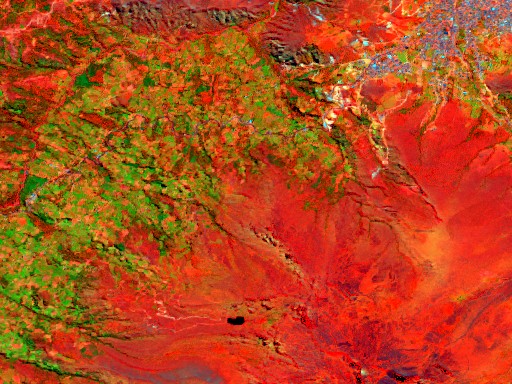
Oxidation (gossans) & hydrothermal-alteration footprints — where a mineral system expressed itself at surface.
Local gravity & magnetic contrast — intrusions, faults & boundaries where metal tends to concentrate.
All-weather radar texture & ground-movement screening — independent of cloud & daylight.
GeaSpirit is powered by the GeaSpirit Engine and connected to the SOST ecosystem. SOST may support future payment and verification infrastructure for GeaSpirit, but GeaSpirit remains fully usable without any blockchain. Holding SOST is not required to use GeaSpirit, and nothing here implies an investment return.
Live Asset Atlas, explainable scores and on-demand reports in 16 languages.
▸ OPEN GEASPIRIT.COMGeaSpirit is an advanced remote sensing and exploration intelligence platform based on multi-source fusion and zone-based validation. It identifies zones with high probability of containing mineral deposits by fusing multiple data sources — satellite imagery, geophysics, geochemistry, hydrology, and geological context.
Unlike traditional exploration, GeaSpirit does not require physical access to the target zone. It operates entirely from publicly available remote sensing and geoscientific data.
"There is [MINERAL] at [DEPTH] at [COORDINATES] with [X%] certainty."
GeaSpirit scores any point on the planet across 4 dimensions:
| MINERAL | 4.0 / 10 | Identify deposit type (porphyry Cu, orogenic Au, sedimentary Cu, etc.) |
| DEPTH | 6.0 / 10 | Gravity + magnetics fusion validated — AUC 0.922 at Kalgoorlie with S2+gravity stack |
| COORDINATES | 7.0 / 10 | Precise location at 30m per pixel resolution |
| CERTAINTY | 8.1 / 10 | Beta-calibrated probability (Brier 0.093, 72% improvement over uncalibrated) |
Canonical Score: 25.1 / 40 (63%) — Phase 48 (gravity fusion validated)
DEPTH improved +1.9 pts from Australian gravity integration (Bouguer + isostatic residual). CERTAINTY improved +0.4 from beta recalibration. Next bottleneck: MINERAL (needs open mineralogical enrichment + temporal feature engineering).
| Zone | Country | Commodity | Best AUC | Dominant Family |
|---|---|---|---|---|
| Chuquicamata | Chile | Porphyry Cu | 0.882 | S2 spectral |
| Kalgoorlie | Australia | Orogenic Au | 0.879 | Magnetics |
| Tennant Creek | Australia | IOCG | 0.841 | Magnetics + gravity |
| Atacama + Uyuni | Chile / Bolivia | Lithium (salar) | 0.891 | Terrain |
| Mt Isa | Australia | SEDEX Cu-Pb-Zn | 0.781 | Gravity |
| Zambia | Zambia | Sediment Cu | 0.760 | S2 + context |
| Madagascar | Madagascar | Graphite | 0.730 | S2 + geology |
| Pebble, Alaska | USA | Porphyry Cu-Au-Mo | — | Analysis in progress |
GeaSpirit is a multi-commodity mineral intelligence platform. Each commodity has a different dominant detection family — the system automatically selects the optimal combination per target type.
| Spectral analysis | Multi-band satellite imagery interpretation | PRODUCTION |
| Thermal anomaly detection | Long-term thermal proxy from 20-year archives | PRODUCTION |
| Hydrological features | Drainage density, watershed analysis | PRODUCTION |
| Neighborhood context | Spatial autocorrelation of deposit occurrence | PRODUCTION |
| Aeromagnetics | National TMI magnetic anomaly data | PRODUCTION |
| Geological context | Lithology classification from open geological maps | SELECTIVE |
| Probability calibration | Isotonic calibration for honest certainty | PRODUCTION |
| GEE integration | Google Earth Engine operationalized for data pipelines | OPERATIONAL |
The following details are available only in the restricted technical whitepaper:
Server-side authentication required.